Dry-land ecologists. People studying the arid lands. Thus armed, he created an Arrakis in which the Fremen conserve and recycle every precious drop of bodily moisture.
The tanned, rolled-sleeve analysts of the US Soil Conservation Service (SCS), collecting bottles of dirt and waxing poetic over grain size and leaf cilia, seem an unlikely source for epic science fiction. Yet Herbert chose these pros as role models for planetary ecologist Leto Kynes. SCS scientists were practical-minded, rooted in the Dust Bowl agricultural disasters of Depression-era Great Plains states. Ecology, for them and the farmers they helped, was a life-and-death proposition. The goal in the Oregon Dunes was to arrest the sands while respecting them.
Selected for the job, European beach grass sounds rather benign and did what it was supposed to do, weaving a tenacious net of shallow roots in the sand and locking it in place. But it came with a downside. It’s an invasive exotic species that’s still there, displacing native plant and animal species. So that people who built homes next to dunes wouldn’t get sand on their driveways. At the time, arresting local problems with invasive plants was a widespread practice that has fallen out of favor. Introducing exotic plants, like kudzu in the American Southeast, almost always brings unintended consequences.
The practice lodged another grain of sand in Herbert’s imagination. Over many generations, his desert planet could be slowly made more habitable, terraformed into a reasonable facsimile of Earth. This becomes a religious tenet of the Fremen.
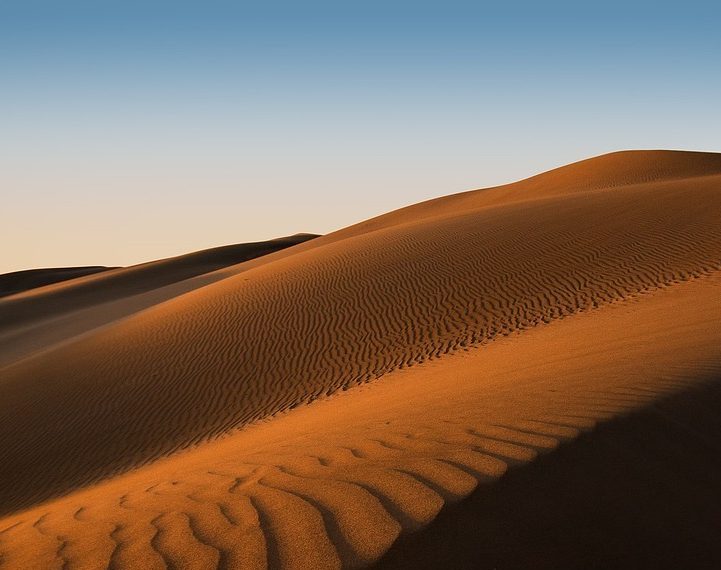
Paring a planet’s ecosystems down to a single, primal type enabled Herbert to sharpen the focus of the novel, transferring the sixty square miles of Oregon Dunes to a world-wide scale. Creeping sands, massive dunes, ever-changing, always on the move. The desert shapes the people. Setting becomes story.
Arrakis is not a world of fragile ecosystems, at least not on the surface. Its landscape consists of never-ending, always restless oceans of sand, punctuated by scattered rocky outcrops. How can you damage that? How can you change that? The local fauna is characterized by worms a thousand feet long and a hundred fifty feet in diameter. But dig beneath the sand and suddenly it’s not quite so barren and simple.
Religious and societal structures are also central to Dune, but are inseparable from environment, like most religions and societies throughout history. Wildernesses in general and deserts in particular loom large in many religions. Holy men go to the desert to endure privation and seek truth.
Dune struck a nerve with a nascent environmental movement in America, coming on the heels of Rachel Carson’s Silent Spring (1962). Carson wrote of the harm done to wildlife by the persistent pesticide DDT. Herbert wrote of societies living within an ecosystem. Combined, these two books made environment a national talking point.
When Ohio’s Cuyahoga River caught fire in 1969, the talking points became a national imperative. The oily, heavily polluted river had actually burned at least nine times before but was shrugged off locally as a byproduct of Cleveland’s industrial prowess. With the 1969 fire, however, people began seeing it in other than economic terms. Something was fundamentally wrong. It’s not a coincidence that the Environmental Protection Agency came into being in 1970.
As for Herbert, although he’d applauded the SCS’s practical approach to dealing with a natural problem in the 1950s, his understanding of environment broadened and deepened. Much like that of the SCS itself, which evolved and became the Natural Resources Conservation Service (NRCS) in 1994. We need long-range vision, Herbert argued, if we intend to be here for the long range.
Arrakis grew out of Oregon’s drifting dunes. Herbert researched them, walked them, came to understand them, and was rewarded by them. Much like young Paul Atreides. Writers would do well to learn from Herbert and get to know a fictional environment before writing one. Follow his lead and you might shift public opinion.
Or at least get to ride sandworms the size of aircraft carriers.